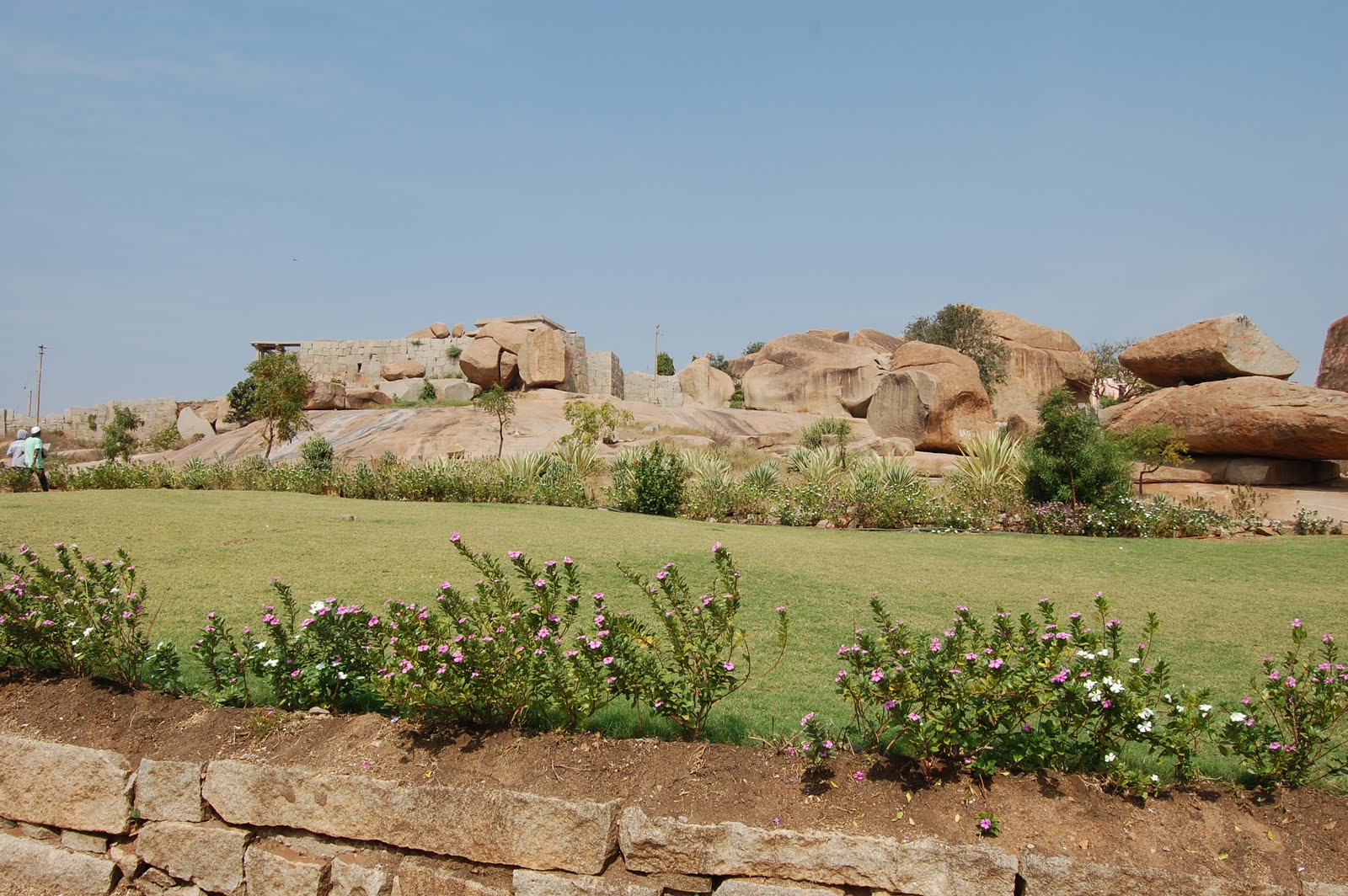
In order to celebrate Christmas of 2009 we went to Hampi with a group of friends. Hampi is at about 400 kms distance from Bangalore. You may go there either by bus, train or a private car. We travelled there by bus for we heard the road to Hampi is quite treacherous. It took us about 6-7 hours approximately to reach our destination.
For those unaware of the historical significance of Hampi, allow me to give a brief account for their sake. Hampi is an ancient metropolis of Vijayanagara dynasty. Once a vibrant city bustling with activity, Hampi is now an abandoned land with ruins of temples, palaces and market places standing as a mute witness to the illustrious Vijayanagara empire.Hampi was at its peak of splendour during the rules of Krishnadevaraya and Achyutadevaraya. But the neighbouring states including Bahamanis, Bidar, Bijapur and Golconda made frequent invasions to Vijayanagara and ultimately in the battle of Talikota defeated the Vijayanagara forces and later ransacked and torched the entire capital.
We caught the bus at night and after an overnight journey, at the crack of dawn we finally reached Hampi enlisted as UNESCO World Heritage Site. It was a cold winter morning and we were chilled to the bone when we alighted from the bus at the bus stop.
Hampi is now a very small town inhabited by a thin population. Only during the season time, tourists throng the city from all across the world. After the sunset, hardly any tourist or resident can be spotted roaming around because most part of the city gets plunged into darkness. So it's recommended that you complete sightseeing before night sets in. There are very few hotels in Hampi and hence it's better to book rooms in advance.
 Upon reaching Hampi once we checked into our hotel, we started looking for an eatery. Since the city is yet to be developed, number of options for good restaurants were limited. We spotted a small but decent hash house near to our hotel and decided on having our breakfast there. The order was placed for puri and potato curry and must I say, the food was delicious regardless of our having to wait atleast close to 40 minutes for the food to be served.
 After the breakfast was satisfyingly consumed and processed for digestion, we headed towards our hotel and within one and half hour got ready to set out for sightseeing. Ringed by mountains, Hampi is an ideal location for people cherishing a fondness for historical places. Personally I admire ancient places that have a bearing on historical import. Needless to say, I was quite captivated by the remnants of antiquated structures. The thought of people, having once lived their lives in a city beaming with glory and happiness but by the cruel stroke of fortune had seen their world toppled and demolished infront of their eyes, roused an eerie feeling inside me.
 The first spot we dropped in at was Kadlekalu Ganesha. It is a monolithic structure of lord Ganesha standing 4.5 meters high, carved out of a single boulder. The seated structure of Ganesha is placed in a holy sanctum with an ornamental pavilion in front. The tall slender pillars built around the pavilion are engraved with the paintings of various Hindu gods and goddesses.
Next in the list of our sightseeing was Sasivekalu Ganesha. Indeed, that in the era of 1500AD, people were very god-fearing and that religion played an important role in keeping them engaged in devotional recreation is manifest through the multitude of temples and holy shrines dotting Hampi. In the absence of technology and materialistic pleasure, the mode of refreshment lied for the common people in various religious festivals and rituals observed and celebrated throughout the year.
Sasivekalu Ganesha is yet another sanctum of monolithic god erected on the slopes of Hemakuta hillock. This four-armed idol perched in an open pillared pavilion was built way back in 1506 AD in memory of a king of Saluva dynasty.
 The pic below is of Lakshi Narasimha Temple famed for its Lakshmi Narasimha image. This magnificent monolithic Lakshmi Narasimha, the 4th incarnation of lord Vishnu, stands at a height of 6.7 meters. Narasimha is seated on the giant coils of the sacred guardian snake of Vishnu and its seven hoods formed a canopy over Narasimha's head.The roof of the chamber enshrining the statue is missing causing much damage to this monolithic structure. The four arms of the statue with its various attributes, have been vandalized purposely, may be during the raid by Bahrains on Vijaynagara and the seated figure of Lakshmi on Lord Vishnu's left lap is missing too.

Below are pics of the ruins of Krishna Bazaar which, in the heydays of Hampi, used to be a gold market abuzz with activity and then in the fateful battle of Talikota in 1565, it was reduced to dust by the enemy force.
One of the must see places in Hampi includes Krishna temple, situated to the north of Lakshmi Narasimha temple. Built by the king Krishnadevaraya way back in 1513 AD, this temple has a huge courtyard with a string of small shrines housed inside the complex. The main shrine of the temple once had an idol of Balakrishna (krishna as an infant) which is now displayed in the state museum of Chennai. The passage leading to the main shrine of the temple is bedecked with beautifully carved elephant balustrades. The pillars and walls of the shrines inscribed with breathtaking paintings of various hindu gods and goddesses would surely make tourists spellbould in awe and reverence for the exquisiteness of craftsmanship.
The pics below refer to the underground Shiva temple situated in a low lying area of Hampi and since the roof of the temple is with the same perimeter of present ground level, it is popularly known as "underground" shiva temple. The main parts of the temple remains under water most of the time and hence entry to the interior portion is limited. Adjacent to the temple is a half built tower with a flight of steepy stairs providing a nice vantage view.


Next we went to visit Vitthala temple, which, built under the patronage of Devaraya II, was one of the largest temples of that era. A substantial portion of the temple were added later during the regime of many successive rulers.The remnants of the temple still exudes the awe-inspiring grandeur of the bygone days. Hewn out of single granite blocks, the main temple and the small shrines built within the temple complex are artistic marvels. The sculpture of four wheeled chariot drawn by two giant elephants evokes adulation from those viewing it. To the east side of the temple is a huge bazaar, measuring 945 meters in length and 40 meters in width leading to a sacred tank known as Lokapavani.


Hampi is teeming with rock formations as far as your eyes can gaze. The temples and some of the ancient structures of Hampi were carved out of these rocks only. On our way to Vitthala, we ran across two huge natural rocks leaning against each other and upon our enquiry to the auto driver, we came to know that these two rocks adjoined at the top tip are known as "sisters rocks" . The auto fellow told us that there is a popular myth going round in people's mouth regarding the sisters rocks like they were cursed by God to petrifaction.Whatever may be the story, the rocks were undoubtedly a treat to the eyes.

Next we rode to Sunset Point. Viewing the sun going down below the horizon from over the huge rocks is a beautiful experience, beyond description. I recall a romantic mood pervading the ambiance with the fall of twilight. We clicked some snaps capturing us busy in animated conversation.
Hampi, as mentioned earlier, has no nightlife for after nightfall, the entire hamlet sinks into pitch darkness. So once back to our hotel, we celebrated the Christmas by cutting cakes and gorging on them as never eaten before. Then we repeated our visit to the same hash house where we took our breakfast in the morning, for dinner. Irrespective of lackluster setting of the eatery, the foods were not disappointing tastewise.
Next day while having our breakfast in the same hash house called "Prince's Restaurant" where a board with handwritten menu was displayed outside, I chanced to take a snap standing next to it :D

 The first spot that we visited on the second and last day of our trip was the remnants of the ticket counter to the underground Shiva temple. From the size of the ticket counter itself, you can gather an idea about the pomp and splendor of the once existing shrine of lord Shiva. Next we went to the Mughal Watch Tower which was constructed after Mughals seized and captured Hampi.It was thrilling to stand upon the projecting balconies of the watch tower while enjoying the beauty spread below.
The pics below are of Hazara Rama temple which is small in size compared to the ones we visited the day before. The name "Hazara Rama" might have something to do with the number of carvings used to decorate the temple. The outer and inner walls of the sanctum are engraved with various depictions of Ramayana.
My heart cried out in pain when I saw the ruins of the Royal palace once inhabited by the illustrious kings of Vijaynagara empire. The palace, ruthlessly ransacked by the invaders, was ground to dust. Very basic foundation apart, nothing else remained of the royal structure.Photos below:
The photos below show the ancient aqueduct of Hampi, used for transporting water from the Tungabhadra river to the tanks and baths of the royal palace and temples and the deep water reservoir where the water was collected and stored for use.
Near to Hazararama temple is located the Lotus Mahal which was the dwelling of the queens and their entourage. Beautifully structured, the Lotus Mahal was an exemplary Indo-Islamic architecture. Photo below:


Built in the style of Indo-Islamic architecture, the elephant stable is one of the least ruined buildings in Hampi. The structure with a row of domical enclosures was used for keeping elephants. The domes are of various types, such as, octagonal, circular, ribbed and fluted in design and are symmetrically laid out. Photos below:
 After a day passed in sated sightseeing, we visited a nice restaurant for our afternoon meal. The same restaurant we also went in for dinner. We ate a lot and the foods were awesome with a variety of continental dishes available to suit any palate. Since the eatery was mostly thronged by foreign tourists, a wide choice of menu was offered. I forgot what all we gobbled, but managed to click snaps of some:
 We started our journey back to Bangalore on the same night by night bus.


 By the time we finished exploring Auroville, it was lunch time and we were famished. There is a small food joint inside Auroville where we had our meal. I forgot what all we ate but the food was of moderate taste.


 Sadly, although I wanted to hang around the Beach road for sometime more, we had to take leave from Pondicherry as we were to return Bangalore that very night and so, without making further delay, we set off for home.